
Standard
Always charges, at least 6 A.
Charges even when your PV produces no surplus at all. If the surplus is higher than 6 A, it automatically uses the higher value.
When to use itYou need the car charged at a set time regardless of the weather.
The app, manuals, SolarSync activation and warranty claims - everything for your charger in one place. Not sure about something? Message Volty, our assistant in the corner of the screen.
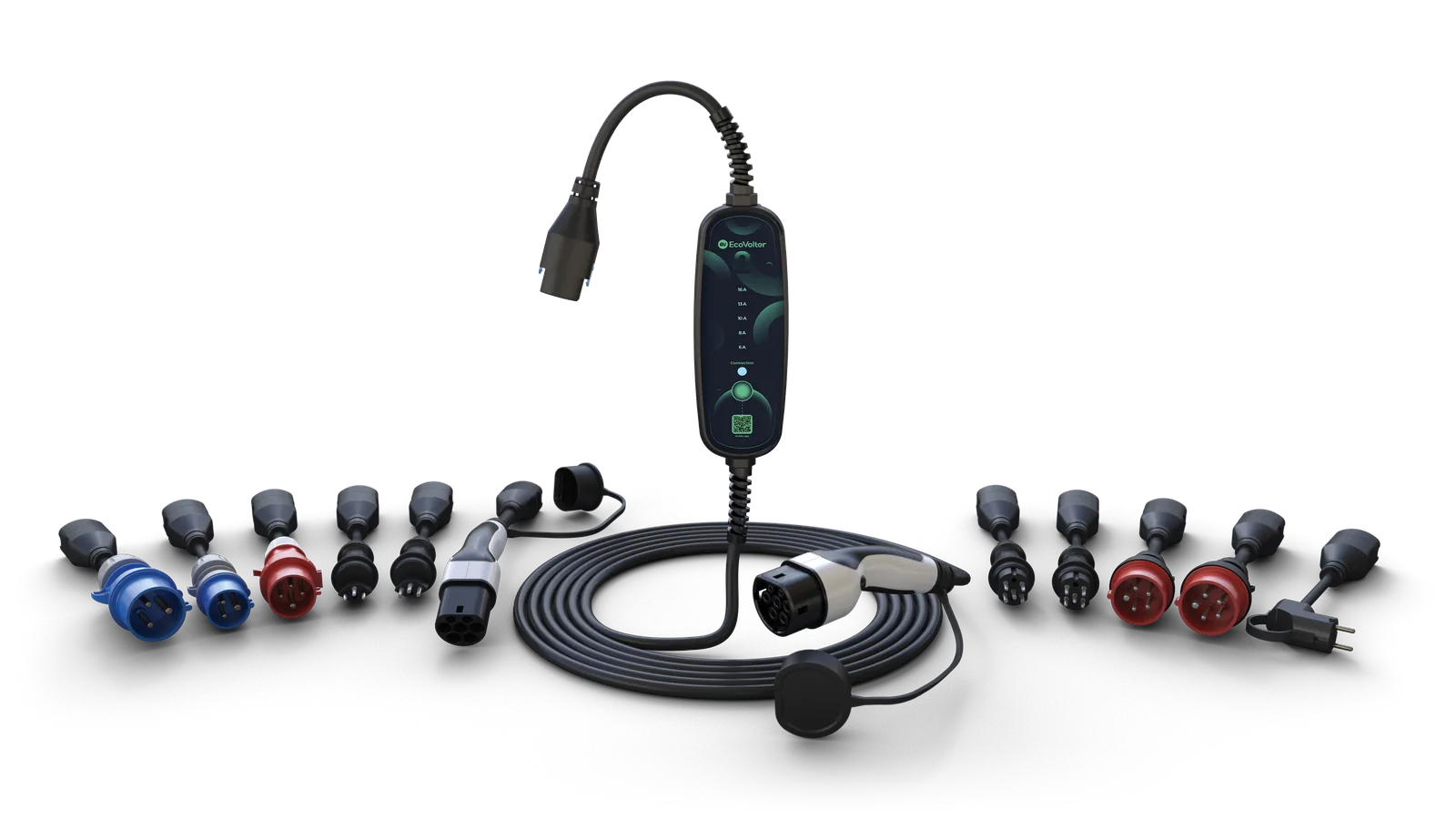
 PRO IIPortable wallbox and the full adapter set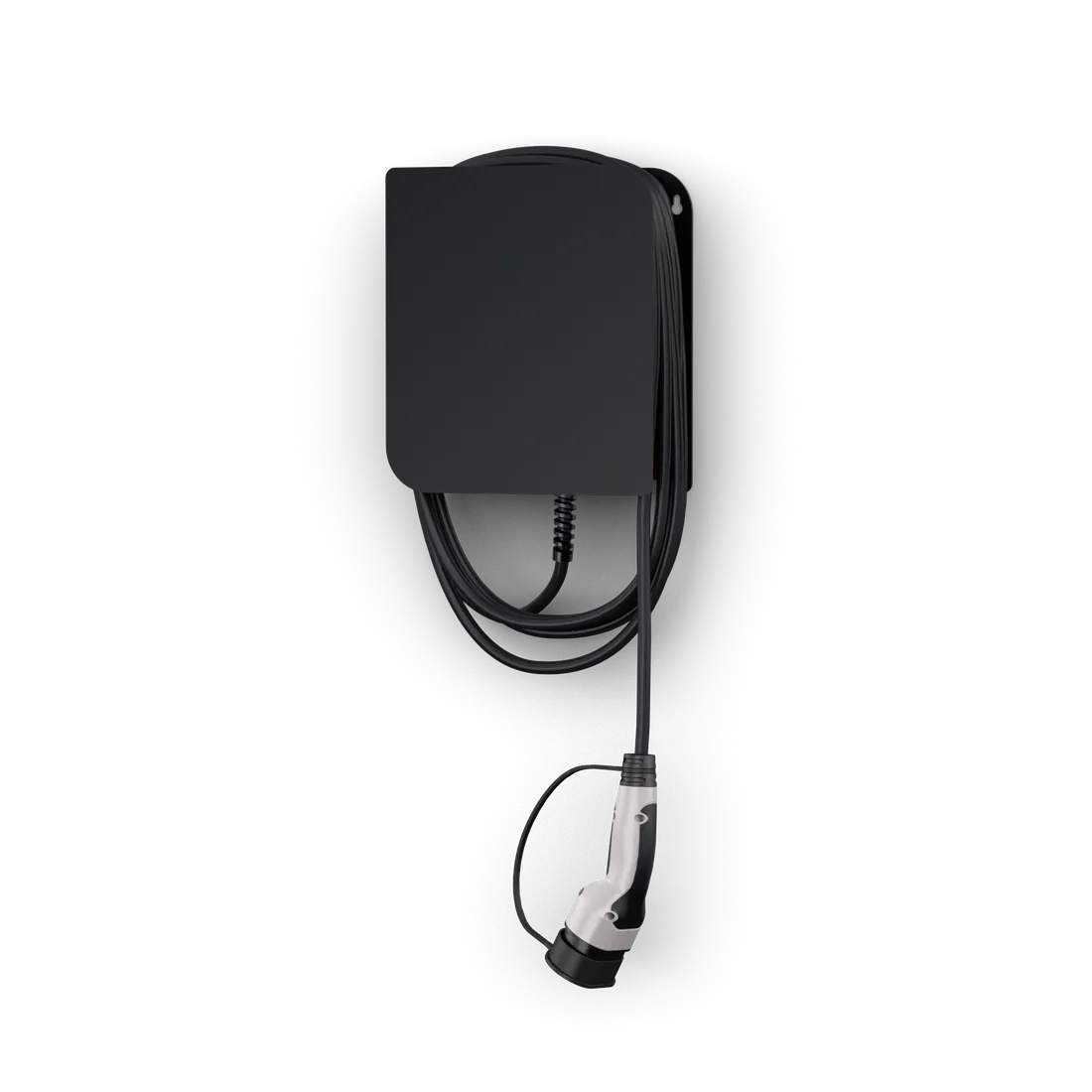
 Wall-mounted wallbox
Pair the charger with your phone and you have all of it at hand: start and stop charging, set the current, use the timer, browse charging history and - once activated - switch SolarSync modes.
A software activation of two features for your charger. SolarSync regulates charging power according to your live PV production across three modes, so you charge straight from your surplus - the same surplus you would otherwise export to the grid at a low feed-in price. ChargeSafe dynamically watches the load on your main breaker so it does not trip while charging.
Both features come in one package. We activate them remotely - no service visit, no installation.
Your PV system produces more than the house is using. The difference would otherwise flow to the grid at the feed-in price.
Either by a Shelly smart meter in your distribution board, or the charger reads the values straight from the inverter over Modbus TCP.
Depending on the selected mode it recalculates the charging current in 1 A steps. ChargeSafe watches the main breaker at the same time and lowers the current before it can trip.
The current mode and the charging session are visible in EV-Manager. Switch modes anytime, the change takes effect immediately.
Switch modes anytime in the EV-Manager app. The change is immediate - charging adapts to the new mode on its own.
Always charges, at least 6 A.
Charges even when your PV produces no surplus at all. If the surplus is higher than 6 A, it automatically uses the higher value.
When to use itYou need the car charged at a set time regardless of the weather.
PV surplus plus up to 3 A from the grid.
Tops up the missing current from the grid, but never more than 3 A. When the surplus is above 6 A it charges purely from it and draws nothing from the grid.
When to use itYou want to save, but you do not want charging to stop over a few amps.
Pure PV surplus, nothing from the grid.
Starts only when the surplus is at least 6 A. If it drops below, charging pauses and resumes on its own once the sun produces enough again.
When to use itYou have time and want maximum savings - weekends, home office, holidays.
| Situation | Standard | Eco | Eco+ |
|---|---|---|---|
| 8 A surplusplenty of sun | Charges 8 Aall from PV | Charges 8 Aall from PV | Charges 8 Aall from PV |
| 4 A surplusless sun | Charges 6 A4 A PV + 2 A grid | Charges 6 A4 A PV + 2 A grid | Pausedsurplus below 6 A |
| No surplushouse draws 4 A from the grid | Charges 6 Aall from the grid | Pausedprotects household draw | Pausedno PV surplus |
You have three options - pick the one that matches what you already have at home. The charger and the meter must be on the same network with a permanent internet connection.
A three-phase smart meter on a DIN rail in your distribution board. The Pro 3EM communicates over Modbus TCP, the classic 3EM over its API. Both measure the flow at the main breaker and pass the values to the charger.
A universal solution for any PV system - Solax, GoodWe, Huawei, SMA, Fronius, Solis, Victron, Deye and systems we have no direct integration for.
No extra hardware. The charger reads the values straight from the inverter over Wi-Fi or LAN.
Owners of a Solax G4 inverter with a datalogger that supports Modbus TCP.
No extra hardware. The charger reads the values straight from the inverter over Wi-Fi or LAN.
Owners of a GoodWe ET series inverter with a Wi-Fi module.
A direct integration for Deye inverters is in preparation. You will get it as a free remote firmware update. No further direct integrations are planned for now - for other brands, use a Shelly 3EM or Shelly Pro 3EM.
A model example: you drive 25,000 km a year at an average of 20 kWh per 100 km, so you use roughly 5,000 kWh.
The example is indicative - it depends on the size of your PV system, household consumption, your tariff and how much energy you actually draw from the surplus.
You will find the serial number on the label on the back of the charger, it starts with REVCR. Add it to the order note.
Up-to-date user manuals as PDFs - always the latest version.
Did not find your answer? Write to info@r-evc.com or call +420 910 926 405. Phone support is available around the clock.
SolarSync regulates EV charging according to your live PV production across three modes: Standard (always charges at least 6 A), Eco (combines surplus with up to 3 A from the grid) and Eco+ (pure PV surplus). ChargeSafe dynamically lowers the charging current when the main breaker is loaded by household consumption, protecting it from tripping. Both features come in one package for CZK 2,690.
The second generation: EcoVolter II, EcoVolter PRO II and EcoWallter. It is not available for the first generation EcoVolter and EcoVolter PRO - their hardware architecture does not support it. If you have a first generation unit, get in touch and we will advise on an upgrade.
Within 24 hours on business days after we receive the payment and the serial number. Orders placed on Friday evening or over the weekend are activated on Monday. You will receive a confirmation email and the features will appear in the EV-Manager app.
The activation is tied to one specific charger, just like a software licence. The serial number is the unique identifier we use to enable the features in your cloud profile. Without it we do not know which unit to assign the activation to and we have to ask.
On the label on the back of the charger. It starts with REVCR followed by a combination of letters and digits. If you cannot read it, send a photo of the label to info@r-evc.com and we will read it for you.
A direct integration without extra hardware works with Solax G4 and GoodWe ET series inverters over Modbus TCP. For any other brand - Huawei, SMA, Fronius, Solis, Victron, Deye - use a Shelly 3EM or Shelly Pro 3EM smart meter, which measures the flow at the main breaker and works universally. A direct integration for Deye is in preparation.
If your inverter has a direct integration, you do not need a Shelly. For other PV brands you do - a Shelly 3EM or Shelly Pro 3EM. We can supply it, you will find it in our shop.
No. The charger needs a permanent connection over Wi-Fi or LTE to communicate with the inverter or the Shelly meter and to sync with the cloud. If you have the Bluetooth-only version, you need to add Wi-Fi first.
In Standard mode the car keeps charging, at least 6 A from the grid even on the darkest days. In Eco mode up to 3 A is topped up from the grid. In Eco+ mode the charger waits until the surplus reaches at least 6 A. Switch modes freely according to the season, or turn SolarSync off and charge conventionally with the timer.
A one-off payment of CZK 2,690 including VAT, no monthly fees. The features work permanently and you get all future SolarSync and ChargeSafe updates, including newly added integrations, free of charge.
Before activation the standard fourteen day withdrawal period applies and we refund without any trouble. After activation the right to withdraw expires - in the cart you confirmed your consent to immediate activation before the period elapsed, which under Section 1837(l) of the Czech Civil Code ends the right to withdraw. This does not apply to defects: if the features do not do what the description says, Section 2389l gives you the right to a repair, a discount or withdrawal. The details are in Article XII of our terms and conditions.
Consumers get the statutory 24 months under Section 2389k of the Czech Civil Code, businesses a contractual 12 months. You submit a claim through the form on this portal - instead of the serial number of the faulty device you enter the one SolarSync is activated on. We are not liable for failures caused by third party hardware (inverter, Shelly, router), an internet outage, firmware tampering, or an inverter manufacturer ending support for their protocol.